
Reviewed · GOLD COAST
Coolangatta: 2 Hour Surf Experience on the Gold Coast
Coolangatta is a fine place to learn surfing because the lesson starts in gentle beginner waves, not in a churning stretch of open water. You learn the basic moves on the sand, walk into waist-deep water, and work toward that first wobbly ride. That first stand is the whole point, and children and adults alike have managed it here.
I like the clear two-hour structure and the fact that the useful gear is supplied, including a soft-top board, rash shirt or wetsuit, and sunscreen. I also like the personal feel of the coaching. Instructors such as Alex, Arthur, Blake, Daniel, and Johnny have been singled out for patient, friendly help. The main caution is simple: surfing is harder than it looks, and one customer found the lesson ended about 20 minutes early. Arrive ready to work, not just pose with a board.
Key points before you book
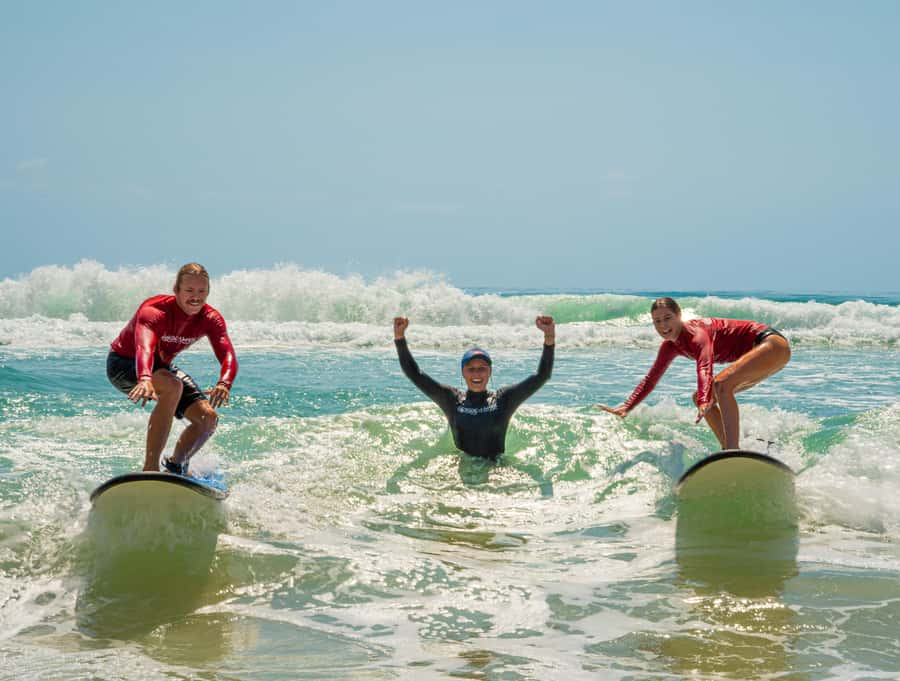
- Beginner-friendly Coolangatta setting: The lesson uses the gentle waves around Coolangatta and Greenmount.
- Two hours of instruction: A Level 1 qualified instructor covers safety, positioning, balance, standing, and board control.
- Useful equipment included: You get a soft-top surfboard, long-sleeved rash shirt or wetsuit, and sunscreen.
- Good for families: Children aged eight and older are welcome, with special supervision rules for children under nine.
- A strong first-surf option: The experience costs $59 per person and has a 4.9 rating from 58 reviews.
- A real physical lesson: Bring water, bathers, and a towel, and expect to spend much of the session in the sea.
Why Coolangatta works for a first lesson
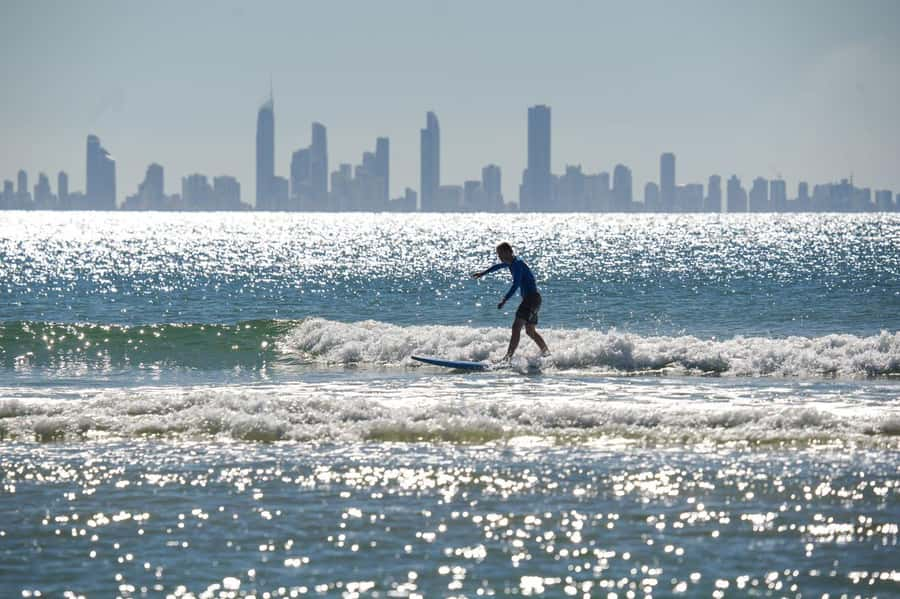
Surf schools need two things from a beach: waves that have enough push to carry a beginner, and water conditions that let an instructor stay close. Coolangatta and nearby Greenmount are used here for their rolling beginner waves and warm, inviting water.
That matters more than a postcard view. A perfect-looking beach can be a poor place to learn if the waves break too hard or too far from shore. Here, the lesson is designed around getting you into waist-deep water, where you can practice safely while still feeling the board move beneath you.
You should not expect to become a polished surfer in two hours. You can expect to learn the basic sequence: lie on the board, find your position, catch a small wave, press up, bring your feet under you, and try to stay balanced. For a first session, standing even briefly is a sensible goal.
The setting also gives you a taste of Coolangatta’s surf culture without requiring a full multi-day commitment. You get wet, handle a board, learn basic beach safety, and find out if surfing deserves more time in your holiday.
More Surf Lessons in the Gold Coast
- Surfers Paradise: 2 Hour Surf Experience on the Gold Coast
★ 4.9 · 1,132 reviews - Learn to Surf at Surfers Paradise on the Gold Coast
★ 5.0 · 491 reviews - 2 Hour Ultimate Learn to Surf Adventure
★ 5.0 · 235 reviews
Finding the Learn To Surf truck
The meeting point is the Learn To Surf truck in the car park overlooking Coolangatta Beach. It is opposite the Coolangatta Rip Curl Surf Shop and Coolangatta McDonald’s, at the eastern end of Marine Parade, or the right-hand side when you face the ocean.
This is the sort of meeting point where arriving 15 minutes early pays off. You can find the truck, check in, and get changed without turning the start of the lesson into a rushed scramble. You should also allow time to locate the car park, particularly if you are unfamiliar with Coolangatta.
Bring your own bathers and towel. Water is also required, which is easy to overlook when the sea is right in front of you. Food and drinks are not included, and you should not bring alcohol or drugs to the activity.
The supplied rash shirt or wetsuit is a useful touch. You do not need to pack a surfing outfit, though you still need suitable swimwear underneath. The soft-top board is the right kind of equipment for a beginner lesson because it offers a more forgiving surface than a hard board.
The first lesson on the sand
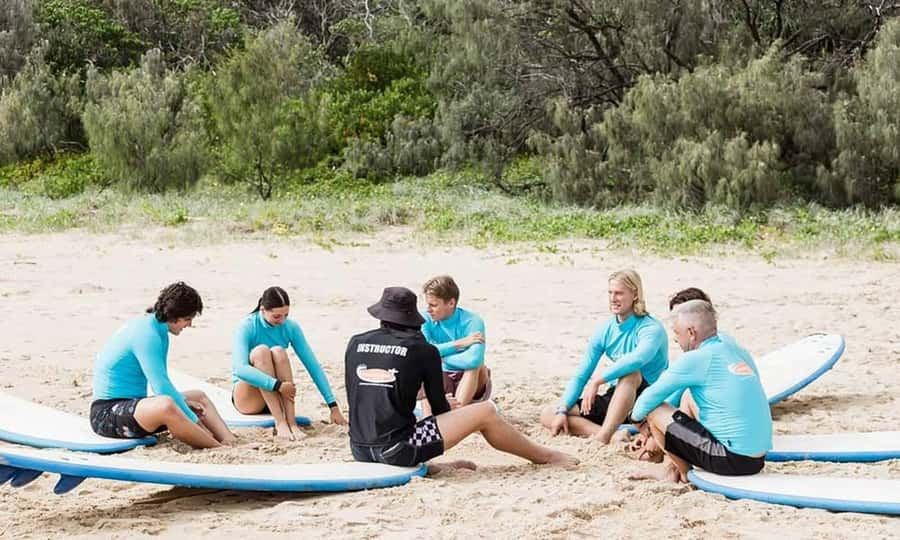
Your session begins with a safety briefing and an introduction to the basic techniques. This is not filler before the fun. The sand lesson helps you understand where your body should sit on the board and what to do when a wave starts moving you.
Board position is one of the first hurdles for new surfers. Lie too far forward and the nose can catch in the water. Lie too far back and the board may not move efficiently. Your instructor shows you how to find the useful middle ground before you have to work it out in the sea.
You will also practice the pop-up, the quick movement from lying down to standing. The lesson focuses on placing your hands, bringing your feet forward, and finding a stable stance. It sounds simple. It is not, at least not the first few times. That is why practicing on the sand helps.
The safety talk also gives you the basics for controlling your board and moving around other people. At a beginner beach lesson, good habits matter. You want to know how to hold the board, where to position yourself, and how to respond when a wave arrives before you are fully prepared.
This first section is especially useful for families. A ten-year-old has reportedly managed to stand and surf by the end of the lesson, but that should be treated as a happy possibility rather than a promise. Children may learn quickly, but they still need to listen carefully and stay close to the instructor.
Moving into waist-deep water
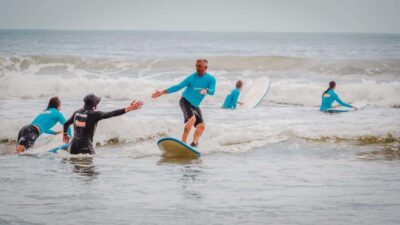
After the sand practice, you head into the water with your board. The lesson description places this work in waist-deep water, which keeps the first attempts manageable and lets the instructor offer direct help.
At this point, you begin to feel the difference between practicing a movement on land and doing it on a moving board. The water shifts your balance, the board slides beneath you, and the wave gives you only a short moment to react. That small dose of unpredictability is what makes the first successful ride so satisfying.
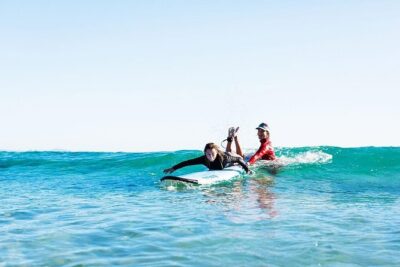
Your early attempts focus on catching the wave and controlling the board. You may remain on your stomach at first. That is useful practice, not failure. You need to learn how the board accelerates before you can stand on it with any confidence.
Instructors guide you through the timing. You wait for the right small wave, position the board, and let the wave push you toward shore. The aim is not speed. The aim is to feel the board glide and learn when to begin the pop-up.
This is where instructor quality makes a real difference. Alex has helped beginners catch their first waves, while Arthur has been praised for making people feel at ease. Blake has also been described as a superb teacher, and Johnny has been noted for being friendly and informative. The names matter because good beginner coaching is less about grand speeches and more about clear, calm corrections at the right moment.
More Surf Lessons in Queensland:
- Noosa Heads: 2 Hour Surf Experience on the Sunshine Coast
★ 4.9 · 644 reviews - Broadbeach: 2 Hour Surf Experience on the Gold Coast
★ 4.9 · 225 reviews - Noosa Heads – 2-Hour Surf Lesson with Expert Instructors
★ 4.8 · 151 reviews - Miami: Group Surf Lesson
★ 4.8 · 146 reviews
The beach regroup and the pop-up attempt
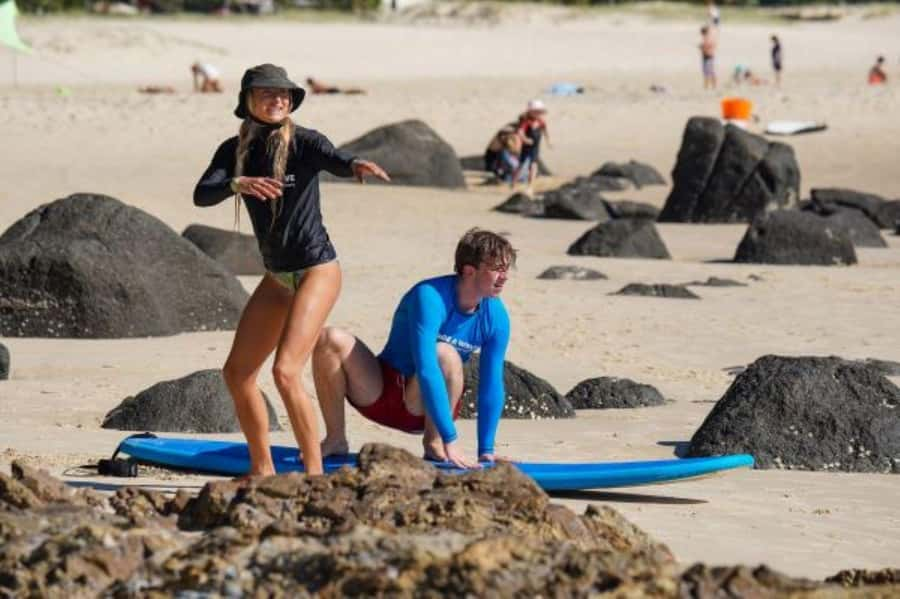
After your first water practice, you regroup on the beach for more instruction. This pause gives you time to understand what went wrong and what to change.
Perhaps your hands were too far forward. Perhaps you tried to stand before the board had enough push. Perhaps your feet landed too close together. These small details are hard to spot when you are busy trying not to fall, so the beach review is valuable.
The second explanation of standing up is usually more practical because you have now felt the board move. You know what the wave does. You know how quickly the moment passes. Your instructor can connect the movement on the sand with the mistakes you just made in the water.
The lesson then returns to the sea for more attempts. This is the point when the session starts to feel less like a demonstration and more like your own activity. The instructor still guides you, but you begin making decisions about board position, timing, and balance.
Do not worry if you fall repeatedly. The supplied feedback includes the useful reminder that surfing is harder than it looks. That is not a criticism of the lesson. It is a fair warning about the sport. A two-hour introduction can give you the tools and a few rides, but it cannot remove the learning curve.
Catching your first wave
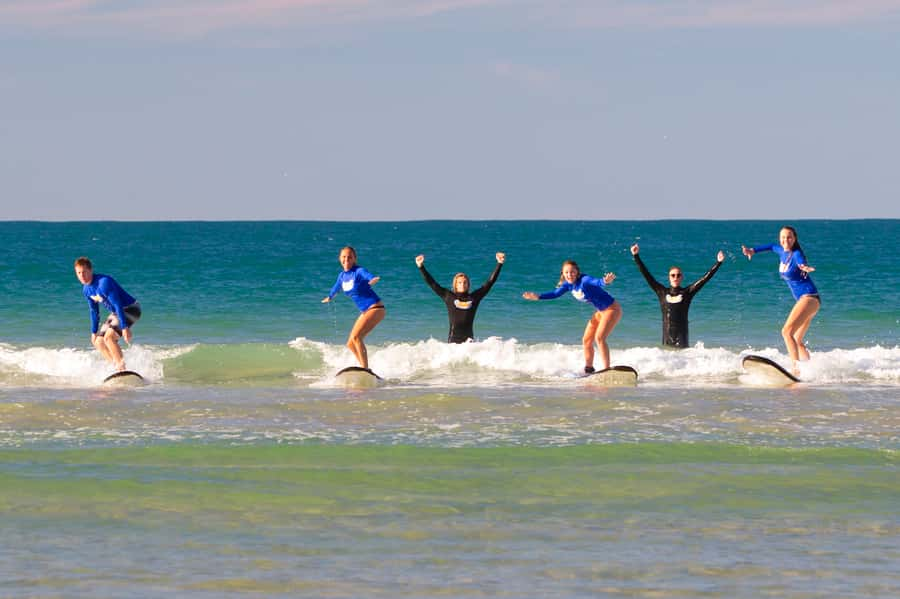
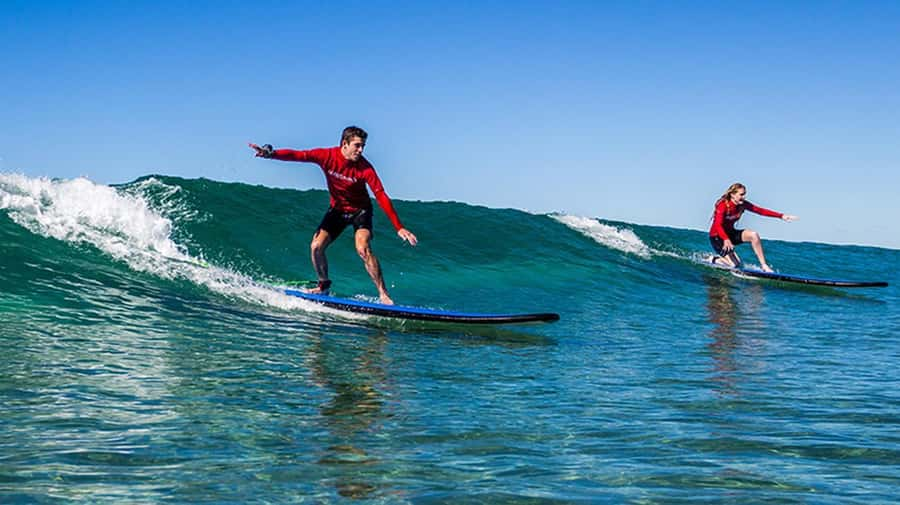
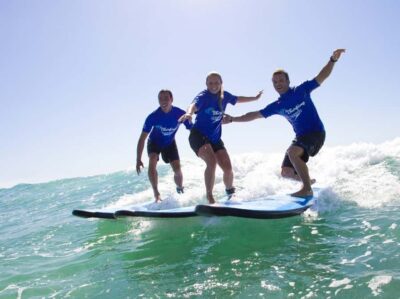
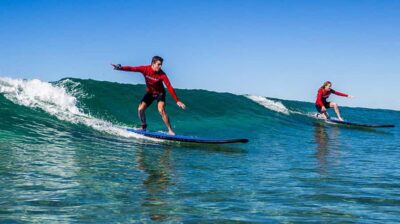
The best moment comes when the board begins to glide and you manage to stand. The ride may last only a few seconds. You may wobble, bend your knees too much, or fall almost at once. It still counts as a real first ride.
You are taught to catch waves, pop up, and control the board rather than simply being pushed toward shore. That distinction matters. A good first lesson should give you enough understanding to keep practicing, not just a lucky ride that you cannot repeat.
The experience is particularly well suited to people who want a physical holiday activity with a clear result. You can measure your progress in simple steps: lying correctly, catching a wave, standing briefly, and staying upright for longer.
The positive feedback is strongest around those practical achievements. One first-time surfer managed to stand up quickly after clear instruction. Another participant described achieving exactly what they had hoped for. Several children caught waves, and one ten-year-old was standing by the end.
Still, conditions and ability vary. A strong first day is possible, but it is not guaranteed for every person in every session. Your result will depend on the waves, your balance, your comfort in the water, and how closely you follow the coaching.
What the $59 price really covers
At $59 per person, the value is strongest if you are a complete beginner who does not own surf equipment. The price includes two hours of instruction, a soft-top board, a long-sleeved rash shirt or wetsuit, and sunscreen.
That saves you from hiring a board and arranging a separate introduction. You are paying for instruction as well as access to the gear, which makes the cost reasonable for a first try. The lesson also gives you a practical answer to the question of whether you actually enjoy surfing before you pay for a longer course.
The main limitation is the short format. Two hours is enough to learn the fundamentals and make several attempts, but it is not enough to build consistent technique. If you catch the surfing bug, the provider also offers a 1.5-hour private lesson and a progressive course of three two-hour lessons.
A private session could suit you if you want more individual correction. The three-lesson course makes more sense if you want steady practice rather than a one-off holiday activity. For a first experiment, the standard lesson keeps your commitment and spending modest.
Availability is shown in a two-to-six-hour duration range, while the core instruction is described as two hours. Check the chosen time carefully when booking so you know the exact session length and start time displayed for your date.
Families, children, and comfort in the water
The lesson is not recommended for children under eight. Children under nine must have a parent who is not taking part in the lesson, and that parent must be able to enter the water to help.
That rule is important. A young child may need support beyond the instructor’s attention, particularly when several beginners are working at once. A parent who can enter the water provides an extra pair of hands without taking part as a student.
The experience suits families with older children who can follow instructions and manage a physical activity. It also suits couples and solo adults who want to try surfing without signing up for a long course.
You should be comfortable getting into the sea and spending time on a board. The activity is not suitable for wheelchair users. No specific swimming requirement is provided, so you should contact the provider if you have concerns about your ability to take part in waist-deep water.
The instructors and teaching style
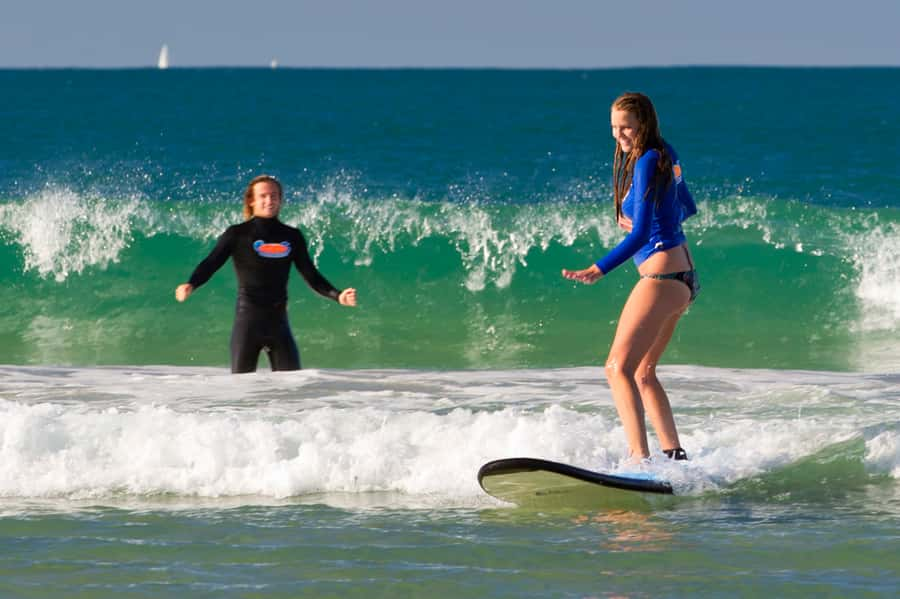
The teaching style described here is friendly and practical. The instructors explain the theory, show you how to stand, and then give you time to practice. That balance is important because too much talk leaves you cold on the beach, while too little explanation can make the water feel confusing.
Alex has helped beginners catch their first waves. Arthur has been praised for making people feel relaxed and for giving easy-to-follow instructions. Blake has been described as a strong teacher, while Daniel helped make one participant’s Coolangatta surf day memorable. Johnny has been noted for his friendly and informative approach.
You should not expect a named instructor in advance. Staff assignments can change, and the available information does not promise a particular coach. The useful point is that the teaching team has a record of helping first-timers through the same basic hurdles.
Instruction is in English. If you need a lesson in another language, this may not be the right choice.
Practical drawbacks to keep in mind
The biggest drawback is the sport itself. Beginners often underestimate how tiring it is to carry a board, paddle or push through small waves, repeatedly climb back on, and attempt the pop-up. You may spend more time falling than standing, especially on your first session.
Timing can also vary in practice. One customer said the lesson finished around 20 minutes early. That appears to be an individual issue rather than the stated format, but you should keep it in mind if you are planning a tight connection or another fixed activity afterward.
The meeting point is public and clearly described, but it is not a hotel pickup. You must get yourself to the Marine Parade car park. You also need to bring the items not supplied, especially bathers, towel, and water.
Finally, the activity does not include food or drinks. Plan to eat before or after the lesson rather than expecting refreshments at the beach.
Who should book this Coolangatta surf lesson?
Book it if you are a first-time surfer who wants a guided introduction in a beginner-friendly beach setting. It is also a good choice for families with children aged eight and older, couples looking for an active morning or afternoon, and anyone curious about surfing but unwilling to commit to a full course.
The lesson is less suitable if you want private coaching from the start, need wheelchair access, or already surf confidently. Experienced surfers may find the basic safety and pop-up work too elementary.
My practical advice is to book this as a first step, not as a promise of instant surfing ability. At $59, the supplied gear and two hours of coaching make it a sensible test. If you stand on one wave, you will have a memorable holiday story. If you do not, you will still leave knowing what to practice next.
FAQ
How long is the Coolangatta surf lesson?
The core lesson provides two hours of instruction. Booking information may show a duration range of two to six hours, so check the selected time and availability for your date.
How much does the experience cost?
The price is $59 per person.
Where do I meet the instructor?
Meet at the Learn To Surf truck in the car park overlooking Coolangatta Beach. It is opposite the Coolangatta Rip Curl Surf Shop and Coolangatta McDonald’s on Marine Parade, at the eastern end of the beach.
What equipment is included?
The experience includes a soft-top surfboard, a long-sleeved rash shirt or wetsuit, sunscreen, and two hours of instruction from a Level 1 qualified surf instructor.
What should I bring?
Bring bathers, a towel, and water. Food and drinks are not included.
Is the lesson suitable for children?
Children under eight are not recommended for the activity. Children under nine must be accompanied by a parent who is not taking the lesson and who can enter the water to assist.
Is the lesson taught in English?
Yes. The listed language for the activity is English.
Can wheelchair users take part?
No. The experience is not suitable for wheelchair users.
Just added around Queensland
- 30 min Jet Ski Safari★ 5.0 · 154 reviews
- Surf Lesson on the Gold Coasts locals Favourite beach (Ages 14+)★ 5.0 · 99 reviews
- 2 Hour Surf Lesson At The Spit, Main Beach (Ages 14+)★ 5.0 · 83 reviews
- Hervey Bay: Best Value Half Day Whale Watching Cruise★ 5.0 · 363 reviews
- Remote K’gari (Fraser Island) & Whale Experience★ 5.0 · 173 reviews
- Hervey Bay Ultimate Whale Watching Cruise★ 5.0 · 260 reviews
- K’gari (Fraser Island) Getaway 3-Day from Hervey Bay★ 5.0 · 36 reviews
- Fraser Experience Shared Full Day Guided Tour★ 5.0 · 76 reviews
Surf Lessons, compared.
Learn to Surf at Surfers Paradise on the Gold Coast
Read our review →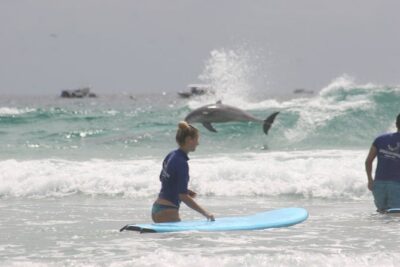
Broadbeach: 2 Hour Surf Experience on the Gold Coast
Read our review →Browse the lists this tour appears in